Math Trek
Abolitionist Gamified Math Through Story, Ritual, and Cosmic Collaboration. In a Harlem Classroom, we boldly lost our minds over Math.

Preface: School Damage
I failed math every single year in high school.
Every year.
I sat in Graham House with my head in my hands, staring at another failed test with blurry eyesight. I needed tutors. I wanted to hide inside of myself. Why was my tutor so loud? Everyone else could hear my struggles. A few adults wondered out loud: “Maybe Andover is not the place for you.”
Years and years later, as a teacher, I read about something called “school damage.” School damage is the idea that, along our academic trajectory, somebody caused harm that stultified our growth as learners.
“Oh no,” I said, looking at myself in the mirror. “Do I have school damage?” And worse: “Am I passing this off to my students?”
This put me on a profound existential path: I knew that saying something louder doesn’t mean a student is going to understand. When a teacher raised their voice at me, it never translated to understanding. Math was brutal, y’all. Sometimes I needed a quiet stairwell where I could sob for ten minutes before walking back to my dorm. Math felt like a locked door, and I was the kid who kept losing the key. Meanwhile, my peers were already learning Advanced Telepathy and Intro to Telekinesis while I struggled with pre algebra. Whose bright idea was it to add letters to mathematical equations anyway? The fact remained, like a given in Geometry: despite heroic efforts with limited resources, Harlem didn’t get me ready for Andover.
So of course, because the universe is wild and God has a sense of humor, years later my principal asked me to teach mathematics to 3rd, 4th, and 5th graders.
I remember laughing out loud in my apartment after reading his email out loud.
“You’re really gonna make me teach math? Okay, Lord. I see You.”
And then I stepped into it.
Brother, I have never seen so many tears in a classroom than the ones I saw during math block. Why don’t they get it? Why don’t they get a concept that was so easy for me back in fifth grade? Why is teaching elementary school Mathematics so difficult? I can hear Mr. Smith in my head saying over and over: “Mathematics is an exact science.”
Fractions broke hearts.
Mixed numbers shattered spirits.
Decimal place value felt like teaching an entirely different language. Just move the decimal over two times to the right!
Right?
Kids would grip their pencils so tightly, their hands read “Ticonderoga.” Some stared at their papers the way you stare at an ocean you don’t know how to cross. I recognized those faces. They were mirrors of my own teenage panic.
I leaned into my dedicated journal practice. I started asking them after every unit assessment or quiz:
“What broke you today? And what do you wish math felt like instead?”
“Whats one thing Robles can do better?”
Their answers were small but sacred:
”I want to go to the nurse.”
“Mr. Robles doesn’t like me anymore.”
“I want to go home and sit on the toilet.”
“I don’t understand the [promblems].”
“When I take a test, my stomach hurts.”
And slowly, with a few artists in class and an absurd amount of trial and error, we created Math Trek. I greeted students at the door, said, “Welcome to Math Trek, we have a new mission today, and we need a captain!” It was rough and tumble at first, not a curriculum, not a textbook replacement, but a story universe we could crawl inside together. I played “Disc Wars” on the Tron soundtrack over and over.
Young Declan said we needed tiny ships to land on new planets to check them out. I ordered a few 30-gallon storage bins to use as landing pods.
Declan said when he watched Star Trek with his dad, they always talk to the bad guys first before fighting. Ok, so I invited parents to be villains, asked them to record something with a mini script.
Declan’s sister, Olivia, said we need to charge the ship first. That can be our warm up exercise. Charging the ship.
Shawn found A YouTube hyperspace video and we projected it on the whiteboard.
We created some hand-drawn crew badges.
You invite students into the collaboration. You build it with the kiddos so that it’s not something an old man put together and handed to them. As a side effect, and as buy-in, they muster the audacity to believe that imagination heals. My own school damage was healing.
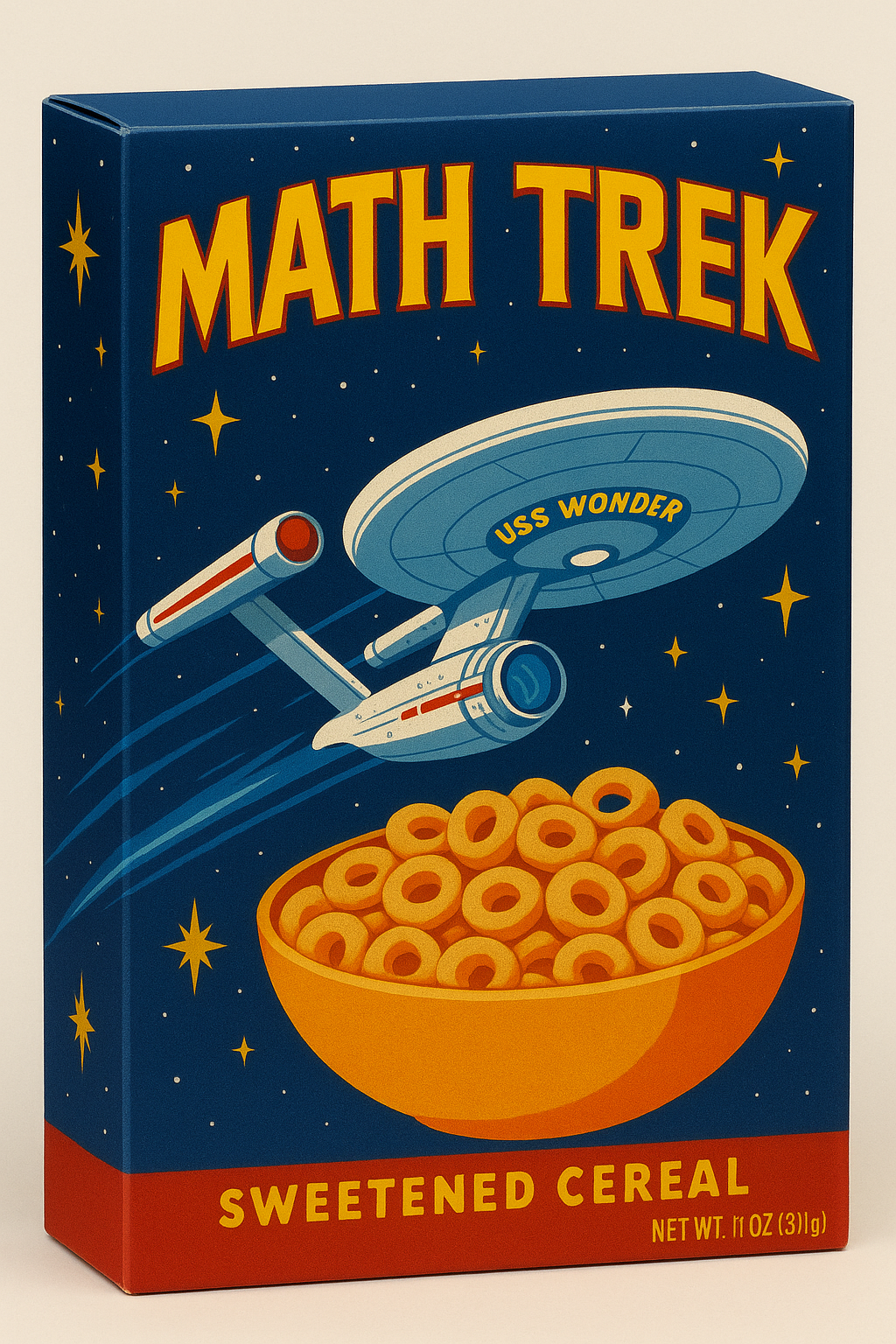
My Harlem classroom transformed itself into the bridge of a starship. The kids started calling it the USS Wonder, and honestly, who was I to correct them? When the lights dimmed and the stars began to streak past on the screen, their shoulders dropped. Their breath steadied. Their faces lit up.
Math didn’t disappear.
Fear did.
And once fear was gone, wonder walked in with both hands open.
They called it Math Trek and they all wanted to hop into the storage bins to fight aliens with Mathematics, but for me, this was an abolitionist, joyful, star-streaked, XP-powered classroom universe where math became a story of courage, curiosity, and cosmic collaboration.
My late father, who was an avid Star Trek fan, thought it was the best thing ever. Miss you, pop.
Math Trek: Refueling the Ship of Wonder
Or: Abolitionist Gamified Math Through Story, Ritual, and Cosmic Collaboration:
① Opening Vignette (Classroom Moment)
The lights were low. The room hummed with the soft whoosh of the Nebula Engines. To boldly go where no Mathemagician has gone before. Okay, technically it was just the white noise machine and a starry-night projection, but the kids swore they could feel the ship vibrating under their feet.
“Captain on deck!” someone yelled, half-joking but half-not, because our elected captain for the day, Jaden, stood tall with a clipboard and the kind of nervous excitement only a fifth grader can carry. On the board, the Star Map blinked with trouble: three damaged thrusters, a cracked navigation array, and a mysterious SOS signal coming from a fractured moon.
Parents, our volunteer “villains”, were on screen, from a video we recorded last week. “Um, that’s my mom!” And I quickly corrected Carl. “No, cadet. That Slartiblartflast the Conquerer!”
Meanwhile, a squad of “Special Forces Engineers” climbed into two 30-gallon storage bins, giggling, legs tucked in, ready to be “launched” to the moon’s surface for a grid-based, turn-based tactical mission.
No one asked, “Is this graded?”
No one muttered, “Why do we have to do math?”
We just followed the mission, with all of its ups and downs. Errors became laughs. On the board, somebody was tallying all of my own errors. It all became a story about chargins the wonder, surviving an asteroid field, strategizing our battles, working together,and a fake shared destiny. The fear and trepidation was forgotten.
They forgot to perform struggle. They forgot the hierarchy of who is “good at math” and who isn’t because we were all on the same ship. In Harlem. Blasting Tron.
② The Lesson / Framework
Math Trek is my abolitionist answer to math fear, math shame, and math hierarchies. It’s a narrative-driven, XP-powered template that can host ANY content: fractions, algebra, geometry, data science: because the real magic isn’t the math.
It’s the story of belonging we wrap around it.
Abolitionist teaching asks:
How do we build classrooms where no child is disposable, and no mistake is fatal?
Math Trek says:
Every miscalculation is a cosmic glitch, and every glitch is fixable when we work together.
Here’s the architecture:
Ritual 1 — Refuel the Ship (Math Centers as Care Work)
Students rotate through warm-up stations designed for success, not sorting:
- Engine Room – quick fluency reps (XP: +5)
- Navigation Bay – word problem decoding
- Hull Repairs – error analysis & growth-mindset check-ins
- Star Garden – SEL journaling: “What math move did I try today?”
The ship only launches when all teams collectively refuel to 100%.
Care becomes a prerequisite for adventure.
Ritual 2 — Elect Today’s Captain
Captaincy rotates as a right of belonging, not a reward for correctness.
The Captain’s SEL moves:
- call on voices that haven’t spoken
- clarify mission objectives
- keep the team grounded when the ship “takes damage”
Students practice leadership, not perfection.
Ritual 3 — Engineers, Weapons, and Special Forces
- Engineers fix damaged parts of the ship via math tasks.
- Weapons Crew use mental math or algebraic reasoning to “target” obstacles.
- Special Forces climb into bins and roleplay grid-based tactical missions, solving math to move, unlock clues, or avoid traps.
UDL at its best:
multiple entry points, multiple identities, multiple ways to matter.
Ritual 4 — Parent Villains
Parents join in as:
- space pirates
- cosmic librarians
- bureaucratic overlords
- trickster aliens
They inject chaos, humor, humanity, grounding the idea that learning is a community endeavor. Acting skills not required. Jenny’s mom probably had no idea, in her wildest dreams, that she would be so good at being Prime Minister of the Galactic Bodega Senate.
Octalysis Drivers Activated: From Yu Kai Chou’s Framework for Gamification:
- Epic Meaning & Calling – Our ship must survive.
- Unpredictability & Curiosity – Missions shift mid-flight.
- Social Influence & Relatedness – Everyone has a role.
- Development & Accomplishment – XP, upgrades, repair logs.
Hero’s Journey: From Joe Campbell’s “Hero with a Thousand Faces,” a personal fave:
Crossing the Threshold.
Students leave the “ordinary world” of busy work, mindless worksheets and step into camaraderie, stakes, and story.
③ Mission Zero: Algebra: “The Phantom Equation”
This mission is Admiral Robles’s personal revenge on high school algebra. If I can get fifth graders to do something I couldn’t do in 9th. Grade, then I’m a BEAST of a teacher, and school damage is completely behind me for good.
Class! This mission is extremely difficult. Are you up to the task?
Yes, Admiral Robles!
I knew you wouldn’t back down! USS Wonder, your ship receives a scrambled distress signal from the fractured moon of Azuron-6. Now I failed this mission back in high school, but I believe that at the fifth grade level, YOU can do what I could not.
“We won’t let you down,” said Olivia.
Objective:
Decode the signal and stabilize the moon’s gravitational field.
Captain’s Opening Script:
“Crew, we have received a fragmented equation. Without solving it, the moon will collapse into its own shadow. Engineers, power up. Weapons Crew, get targeting systems online. Special Forces, prepare for drop.”
Algebra Task:
The moon sends this message:
“I am held by a force equal to 3x – 7,
but the shadow pulling me is 2x + 8.
Balance me, or I break.”
Students must solve:
3x – 7 = 2x + 8
to find the gravitational equilibrium.
Engineers (Worksheet / Whiteboards)
Solve the equation step-by-step.
Every error triggers a “hull crack”—Captain decides how to respond with grace.
Weapons Crew (Mental Math + Strategy)
Once solved, they must plug the value back into a targeting formula:
Energy Output = 5x + 12
This determines how much power the ship can safely emit.
Special Forces (Grid Map Mission)
Each square requires solving a mini algebraic puzzle to move.
Some squares contain alien spores that trigger SEL reflection prompts like:
- “Where did I get stuck and how did I try to move forward?”
- “Who do I need as an ally in this moment?”
Parent Villains
Zoom in yelling: “Your equation is FALSE! Try again, Earthlings!”
(Students immediately re-check with urgency, and laughter, and “whose grandma is that?”)
XP Mechanics
- First correct solve: +20 XP
- Helping a peer with dignity: +10 XP
- Naming your confusion aloud: +15 XP (Abolitionist Bonus)
- Restorative Repair after a ship “error”: +5 XP
Restorative Circle Prompt at Debrief:
“What math moment today made you braver?”
Why Math Is Hard for Kids (The Real Reason)
And I could be wrong about ALL of this. But in my rough experience as a student of Math, followed years later by my rough experience teaching elementary school math for three years, I realized that math is not hard because kids lack ability.
Math is hard because:
- it’s been taught as a performance, not a process
- we rank kids before we understand them
- mistakes feel like moral failures
- shame calcifies around numbers
- too many adults say “I was never a math person”
And students rarely feel safe enough to take risks
The hope is that something like Math Trek dismantles the shame.
The hope is that it re-humanizes the work.
The hope is that it gives mathematical struggle a narrative worthy of their courage.
But ultimately, we’re inviting students into the equation, and they become bold. You like that one, dad? They boldly go.
④ Closing: A Prophetic Blessing for the Young Mathematicians
I tell my students:
“You were not born to fear numbers.
You were born to build worlds.”
And every time they patch a hull crack, decode a phantom equation, or climb out of a plastic bin roaring with triumph, I remember:
children are cosmic makers.
They want meaning, not worksheets.
They want belonging, not benchmarks.
They want story, not shame.
Math Trek is my reminder that every child deserves a universe designed for their brilliance.
They get a ship where they matter,
They get a mission where their voice shapes the stars,
They get a classroom where joy is the fuel that propels us forward.
Because every child deserves a classroom designed for loving.
Further Reading: Transforming your Harlem Classroom into The USS WONDER!
- Bridge (Leadership & Mission Control)
Where the Captain, the Pilot, and the Navigator chart the mission.
Giant star map projected.
Alerts glow red when the ship “takes damage” due to math mistakes, misunderstandings, or villain interference.
Captain’s SEL Role: call on quiet voices, refocus energy, encourage collective problem solving.
Octalysis Drivers: Social Influence + Meaning
- Engineering Bay (Math Repair Team)
Students rotate here to fix:
- broken thrusters
- glitchy navigation systems
- hull fractures
Every repair requires math reasoning, and each correct repair restores “ship integrity.”
Engineers earn XP for:
- explaining their steps aloud
- revising errors
- helping a peer with love and dignity
- Weapons & Defense Systems (Logic & Strategy Lab)
Not actual violence—just cosmic calibration.
Students use:
- mental math
- algebra
- probability
- geometric modeling
…to stabilize shields, retarget sensors, neutralize anomalies, or “jam” villain transmissions.
Weapons Crew specialize in quick thinking under pressure.
- Special Forces Deployment Bay (30-Gallon Planet Drop Pods)
The plastic bins become:
- landing shuttles
- tactical pods
- stealth capsules
Special Forces teams use grid-based, turn-based tactical maps to move across alien terrain.
Every move costs Action Points, earned by solving mini-problems.
If they encounter hostile creatures?
They must negotiate, outsmart, or mathematically outmaneuver them.
- Med Bay (SEL + Math Anxiety Care Station)
A quiet corner for:
- breathing exercises
- “math decompression”
- reflective journaling
- peer support roles
The Med Tech keeps track of emotional energy levels.
No stigma.
Just restoration.
- Cargo Hold (Manipulatives + Tools)
Whiteboards, blocks, counters, dice, fraction bars—
anything needed to make thinking visible.
CREW ROLES
1. Captain (rotating daily)
SEL Leader • Encourager-in-Chief
Recites the Ship Oath before launch:
“We fly by wonder.
We learn in community.
We repair what breaks.
We rise together.”
XP: +10 for every moment of dignity shown during challenges.
2. Engineers
Math repair specialists.
Fix ship systems through problem-solving.
XP: +2 per correct step, not per correct answer.
3. Weapons Crew
Strategists and pattern-finders.
Use algebra, logic, and probability to keep the ship safe.
4. Navigation Team
Decode:
- word problems
- coordinates
- rate/distance puzzles
- functions
Plot the path through asteroid fields.
5. Special Forces
Planet explorers.
Solve tactical puzzles using grids and coordinates.
6. Med Techs
Guardians of belonging.
Offer:
- affirmation cards
- “You’re safe to think here” reminders
- reflective check-ins
RITUALS OF THE USS WONDER
Ritual 1 — Refuel the Ship
4 Stations: Fluency • Navigation • Repairs • SEL
The ship launches once the crew reaches 100% WonderFuel.
Ritual 2 — Damage Report
If misunderstandings occur:
Sirens flash.
The hull cracks.
Captain leads the Repair Circle:
“What went wrong?
Where did we get lost?
How do we repair it together?”
This abolishes shame.
Ritual 3 — Captain’s Log
End of mission reflection:
- What math move made us braver?
- Who supported the team today?
- What did we discover?
Ritual 4 — XP Awards
- Growth Mindset Move: +10
- Helping a peer: +15
- Naming confusion aloud: +20 (Hero’s Honesty Bonus)
- Collaborative Solve: +25
- Keeping joy in the room: priceless
Math Trek Mission: “The Fractured Moon of Luma-9”
4th Grade • Fractions • Story-Integrated Math Centers
Narrative Setup (Captain’s Log)
“Crew, we’ve received a distress call from the moon Luma-9.
Its surface has cracked into unequal pieces, and the moon’s ecosystem is failing.
We must identify each fraction of the moon, redistribute energy equally,
and help restore balance before the entire moon collapses into stardust.”
The lights dim.
The hyperspace video hums.
The kids slip into those 30-gallon pod bins, giggling as they prepare for descent.
But when their consoles light up… they’re all business.
Because fractions feel different when the mission depends on them.
Mission Objective
Students will recognize, compare, create, and decompose fractions to stabilize the Fractured Moon of Luma-9.
Crew Roles
Captain (rotating student leader)
Reads the mission aloud, keeps the crew calm, and asks clarifying questions.
Engineers
Repair moon fragments by labeling and matching fractions.
Navigation Team
Plot safe coordinates using benchmark fractions (½, ¼, ¾).
Special Forces
Deploy via storage-bin drop pods onto a grid map of the moon’s crust.
They must “step” on correct fractional tiles to move.
Med Bay Keeper
Checks in with anyone who gets overwhelmed (“What part felt confusing? What helped you move forward?”)
Mission Centers (Fractions Edition)
Center 1: Hull Repair Lab — “Fix the Moon Pieces”
Students receive moon fragments (paper circles or rectangles) cut into:
- halves
- thirds
- fourths
- sixths
- eighths
Task:
Match each labeled fraction (e.g., 3/4) to the correct piece.
Then color the fraction to recharge its energy core.
Captain Script:
“Engineers, restore the moon’s energy by identifying each fractional part.
Every correct match repairs a crack.”
XP: +10 per accurate repair
Abolitionist Note:
Mistakes = “micro-cracks” → we fix them together.
Center 2: Navigation Bay — “The Fraction Flight Path”
A star map shows different celestial objects at fractional distances
(e.g., ½ light-year, ¾ light-year, ¼ light-year).
Task:
Students place fractions on a number line from 0 → 1
and choose the safest path based on the distances.
Challenge Question:
“Is 2/4 closer to 1 or to 0? Show how you know.”
XP:
+5 for placing, +10 for explaining reasoning aloud.
Center 3: Weapons Console — “Equal Energy Bursts!”
Weapons crew receives fraction cards and must generate equivalent fractions to power the shield.
Example:
1/2 → 2/4 → 4/8
2/3 → 4/6 → 6/9
Task: Create as many equivalent fractions as possible in 3 minutes.
Captain Prompt:
“Equivalent fractions = stable shields.
Without them, the ship is vulnerable!”
Center 4: Special Forces — Grid-Based Tactical Fraction Mission
Special Forces are deployed onto the moon using their storage-bin drop pods.
Once “landed,” they move on a floor grid where each square contains a fraction.
Rules:
- Students can only move onto fractions greater than ½.
- Lava zones are fractions less than ¼.
Alien nests are improper fractions (they must solve them to escape).
Sample Alien Math Challenge:
“Convert 5/4 into a mixed number.”
XP: +15 for teamwork, +10 for each correct step.
Restorative Circle Debrief
After the mission, everyone gathers for a 2-minute reflection.
Captain Asks:
- “Which fraction felt hard today, and what helped you keep going?”
- “Who supported you during a tough moment?”
- “What did you learn about the moon—and about yourself?”
Blessing:
“Your courage to try, revise, and question restored Luma-9.
No fraction of you is ever missing.”
Rewards & Badges
Tarot Badge: “Luma-9 Stabilizer”
Earned for:
- explaining a fraction
- helping someone decode a fraction
- demonstrating persistence
XP Bonus: “Captain’s Courage”
+20 XP for naming confusion aloud (Math Trek always rewards vulnerability).
Why This Mission Works (Teacher Side)
It sneaks in:
- partitioning shapes
- identifying fractions
- comparing fractions
- equivalent fractions
- benchmark fractions
- reasoning & modeling
- SEL collaboration
- leadership roles
…all wrapped in a story that dissolves math fear and replaces it with adventure.
Boldy Go, Co-Conspirators!